


Do Ebikes Need to Be Registered? A State-by-State Guide
Updated: Author: ErpanOmer
Electric bikes are now gaining momentum in the United States. However, a question that may always arise is, should electric bikes be registered? This is based on a number of considerations. They may include your location, the classification of your ebike, and the power of your motor.
Some of them are treated similarly to ordinary bicycles, meaning no registration is necessary, whereas other states treat the ebikes as motorcycles, meaning that the latter are legally obliged to be registered.
This guide includes U.S. ebike classifications, factors influencing registration, a state-by-state look, the way to register one where necessary, recommended Urtopia ebikes, and what other legal factors may or may not apply to a U.S. ebike rider.
Understanding U.S. eBike Classification and Regulation
Knowing the U.S. ebike classification and regulation is essential for riders and retailers. The three-class model is the most prevalent in the U.S. regarding the regulation of ebikes, and understanding these electric bicycle classes helps ensure safe riding and compliance with state laws:
- Class 1: Pedal-assist, limited to a maximum speed of 20 mph.
- Class 2: Pedal-assist & throttle, limited to ~20 mph.
- Class 3: Pedal-assist only, limited to ~28 mph.
One of the outcomes of this program is that the ebikes that are more like a normal bike than a motorized vehicle are differentiated. Usually, the Class 1-3 ebikes are not subjected to registration with the DMV in any state; nevertheless, a device that is driven beyond a state-specific speed or is more powerful can be categorized as a motor vehicle.
Key Factors Affecting E‑Bike Registration Requirements
The registration of e-bikes is dependent on various factors. These may include motor power, maximum speed, and the purpose of use. These are the most significant factors that not only help to understand but also clarify the necessary registration.
- State law: All states have different laws on ebikes.
- Power, speed: Motors having a higher wattage or speed might be categorized as motor vehicles.
- E-Bike category: When compared to Class 1 or 2, Class 3 bikes frequently attract stricter policies.
- Local regulations: Cities or counties have some other specifications.
- Labeling: In certain states, there must be a permanent label indicating class, maximum speed, and motor power.
E‑Bike Registration Requirements: State‑by‑State
Various regulations of registration of e-bikes are implemented across the U.S. and differ based on the laws of the state and the characteristics of e-bikes. It may be useful to know which states need to be registered to avoid penalties and be a compliant rider.
| State | Registration Required? | Notes |
|---|---|---|
| Alaska | Yes | Requires an operator’s license; ebikes are more like motor-driven cycles. |
| Hawaii | Yes | Has stricter regulations, and some ebikes are treated as mopeds. |
| Massachusetts | Yes | E-bikes may require registration under moped laws. |
| New York | Potential / Proposed | Some proposals exist to require registration, but not universal yet. |
| California | No (for most) | Class 1–3 ebikes generally do not need DMV registration. |
How to Register Your Electric Bike in the U.S.
When your state demands to have ebikes be registered, taking the right steps will make it an easy and legal one. The following is an approximate guide to help you get going.
1. Steps for DMV Registration
- Look at your state DMV or transportation site.
- Identify your ebike class.
- Make sure a permanent label with class, speed, and power is attached.
- Enter required documents: purchase evidence, manufacturer, and personal ID.
- You may pay a registration fee.
- Get a license plate or sticker with which to pin your ebike.
2. State-Specific Requirements
- California: Standard ebikes do not require registration. So, the high-power bikes can be subject to moped regulations.
- New York: There can be changes in registration demands; it is necessary to check the local regulations.
- Texas: Abides by the three-class system; registration is generally unnecessary.
3. Necessary Documents and Fees
- Invoice of sales or purchase receipt.
- The specification sheet of the manufacturer.
- Serial number (if assigned).
- Personal ID.
- Registration fee (depends on the state).
Above, these are the necessary documents and fees when registering your ebikes in the U.S.
A Smart and Legal Option: Urtopia E‑Bikes
Urtopia sells riders the more powerful and still legal ebikes, but they are more likely to fit under the standard rules of Class 1-3 and not require DMV registration.
Urtopia Carbon Classic Step-Thru E-Bike

Urtopia Carbon Classic Step-Thru is geared towards a person who desires comfort and practicality every day. As an electric city bicycle, it is easy to mount and ride due to a step-thru carbon frame. Besides this, it is powerful on hills because the 750W motor gives it serious acceleration and great smoothness. This model integrates with lightweight building, high-tech torque sensing. It is best for urban roads, bike lanes, and extended daily commuting- all without breaking most laws on state ebikes.
Key features:
- Motor: 750W rear hub including torque sensor.
- Range: Up to 75 miles.
- Weight & Charger: 38 lbs, Lightweight and 2.5H fast charger.
- Class: 2 eBike.
Carbon Joy Ultra E-Bike

Carbon Joy Ultra is designed for a stylish, high-quality, and fat tire electric bike to use in the city. This ebike defines the ease of delivering power, a lightweight carbon frame, and the latest design. Besides this, it simplifies travelling each day with pleasure. In traffic, riding around the neighborhood, or getting to work, Joy Ultra provides a classy ride experience. So, it fits neatly into Class 1-3 regulations- i.e., the vehicle does not need a license in most states.
Key features:
- Motor: 750W rear hub, 60 Nm torque.
- Range: Up to 70 miles.
- Weight & Charger: 42 lbs and a 3.5H fast charger.
- Class: 2 ebike.
Urtopia Carbon Fold 1 E-Bike
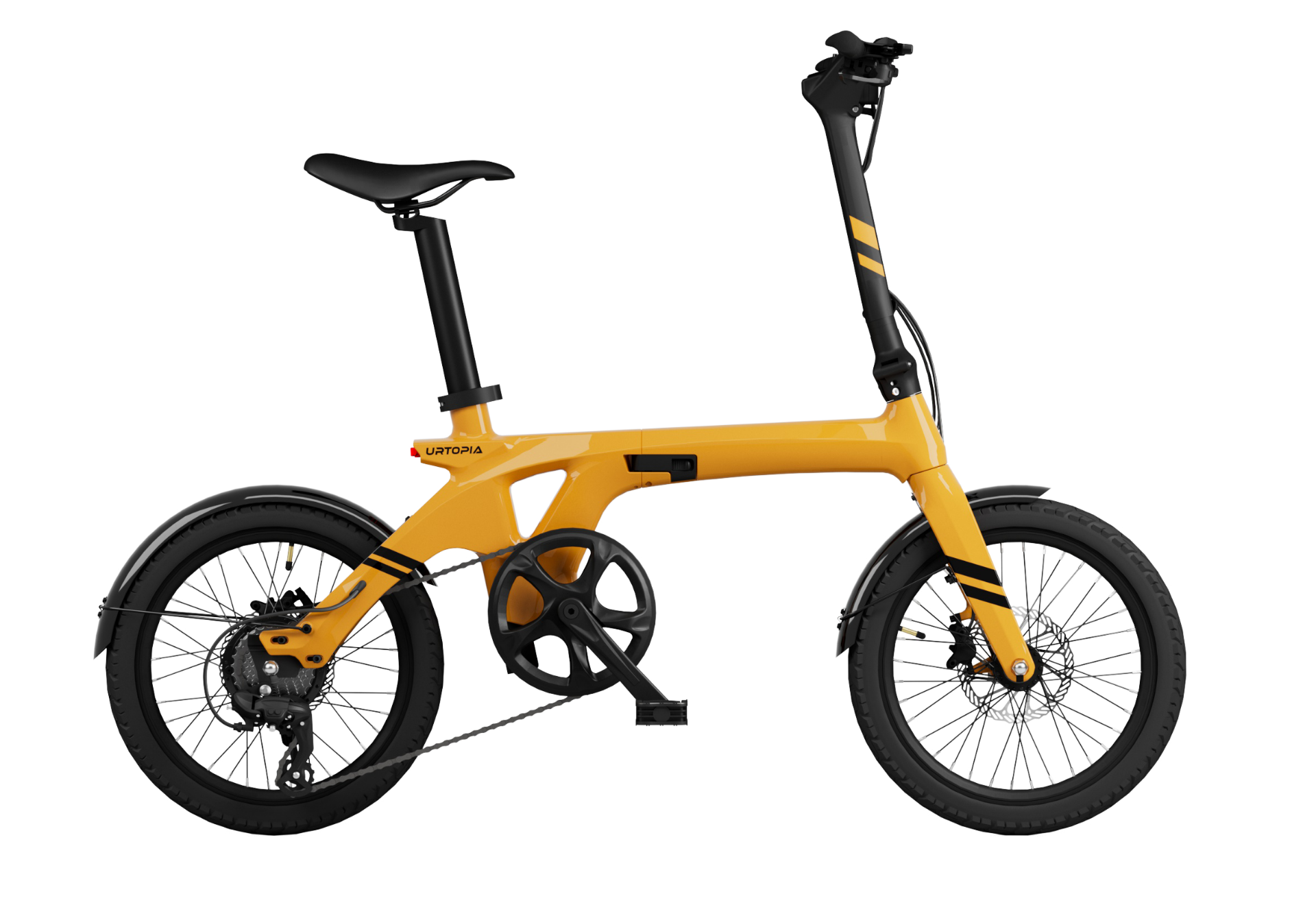
The Carbon Fold 1 is among the lightest and smallest foldable e-bikes available to meet the needs of riders. They are best for those who require portability without a significant degradation of performance. Moreover, the carbon fiber frame makes the bike very light, and the 500W motor gives it sufficient power. It can cover urban commuting and lower hills. Furthermore, it is apartment-friendly, as well as Class 1/2 in most states, requiring no registration at all.
Key features:
- Motor: 500W rear hub, 42 Nm torque.
- Range: 40miles.
- Weight & Charger: 29 lbs and a 3H fast charger.
- Class 1/2-friendly motor: typically does not have to be registered.
Other Legal Considerations for E‑Bike Riders
Despite the absence of registration requirements, riders should take into consideration:
- Age limits: Age limits are imposed by some states, particularly on faster or throttle-equipped ebikes.
- Helmet laws: Sometimes necessary with Class 3 ebikes or buyers under 18.
- Labeling: Must label with permanent class, speed, and motor power.
- Local regulations: A city or county law can restrict the areas where ebikes can be ridden (bike lanes, trails, etc.).
FAQs
Do all electric bikes need to be registered in the U.S.?
No. The registration requirement for e-bikes depends on the specific state or local jurisdiction, but there are no general requirements to register e-bikes of Class 1-3.
What is the registration of class 1, 2, and 3 ebikes?
Typically, the bikes of Classes 1-3 are treated in the same manner as regular bicycles. However, the majority of the high-powered motor vehicles can be. So, they must be registered.
Are there age restrictions for riding e-bikes in certain states?
Yes. Several states have minimum ages, particularly for Class 3 throttle-based ebikes. But vary in different states, in many states, riders must be at least 16 years old to operate a Class 3 e-bike.
Conclusion
The question of whether your ebike requires registration depends on the state where you are, the type of your ebike, and the motor power. In the majority of U.S. states, there is no registration requirement for typical Class 1-3 ebikes.
Though ebikes with high power or faster speed might be motor vehicle laws. Providing legal and registration-friendly ebikes, such as the Urtopia Carbon Classic Step-Thru, Joy Ultra, or Carbon Fold 1, offers reliable, powerful, and light versions that are in compliance with most state laws. Knowing legal and local regulations and getting the appropriate e-bike will guarantee a legal and secure ride.


